Tuesday, 18 October 2011

And onwards to Windhoek!


Jane, Harry, Kin amd me at the
Africat offices
And so we come to the end of the first 2 weeks of my adventures in Africa. It has been hard work, and I have plenty of cuts and bruises to show for my hard work! I have learnt so much about the animals and the place, and the people have been really good fun. Clive and Roma, who run the project, are incredibly passionate about the work that they do here along with all the volunteers, and Beth who helps to run the project (and coincidently is Australian) knows so much about the plants and animals of the reserve. To end my time on the project we had a visit to the Rare and Endangered Species Trust, where I got to feed a vulture!

There were 11 volunteers helping throughout the 2 weeks from across Europe and further afield. There were certainly a few characters in the group, but a lot of hard workers and a lot of laughs were had by all. Luckily there were a few people who stayed on in Windhoek after the project had finished, which was nice because it meant that I wasn’t alone while I was there. On the way back to civilisation we stopped off at an African wood market which was an experience- every two steps a vender would ask if we would like to visit their stall, and we were told that if we wanted anything we should halve the asking price and haggle from there!

Christuskirche, Windhoek
On the recommendation of every person who had ever been to Windhoek, and every guide book going, we booked into Joe’s Beerhouse. I can tell you, everyone was not wrong! I had an amazing kebab of ostrich, zebra, kudu, springbok and chicken (very strange having spent 2 weeks watching half of these animals from a truck!). I would definitely recommend zebra if you ever get the chance to try it (as cute as they are!).


Cocktails on the roof of the Hilton Hotel
Windhoek itself is quite small, and not particularly interesting. All of the locals warned us that Windhoek was not very safe but I didn’t run into any problems- apart from the internet being so very slow! I was fortunate that one of the other volunteers had far too much money and not enough sense, and was staying in a suite at the brand new Hilton Hotel. So for two days myself, Anja and Ben sunbathed by the pool, sipping cocktails and eating good food. It was a nice relaxing way to end my time at the project before starting my adventure tour of Namibia.

Tuesday, 27 September 2011

Bushman Walk

One of the other activities we have done whilst on the project was the Bushman Walk, where 2 of the local workers, Felix and Peter, took us on a walk though the bush and taught us about the lives of the tribal hunters who have lived on the land for thousands of years.

Back before white men invaded Africa, there were 2 main modes of living for the tribes- above the equator the Bantu people farmed livestock and grew crops, and below the equator lived the San or Bushmen who were hunter-gatherers. The people lived peacefully together, trading animal skins for metals and other crops, however the San started to hunt the livestock of the Bantu people, creating conflict between the 2 peoples. Simultaneously, European invaders in the south were extending their rein over the country and forcing the San out of their natural hunting grounds. Now the San people are confined to a much smaller area, mainly in southwest Africa, but they are recognised for their cultural and historical value by the government and so are given a protected status. Modern San tribes are no longer nomadic, and have set up villages and adopted a more modern style of living.
 
Felix and Peter preparing a bird trap

In preparation for long hunting trips, the San people would locate ostrich eggs from the nest and make a hole in the top of the egg, cook the egg and eat the yolk. Then they would then coat the inside of the shell with honey and leave it for the ants to eat the leftover egg. They would locate honey by attaching a thread to a bee and finding where the thread is left thus finding the bee hive. The empty shell would then be filled with water, sealed with beeswax and buried in areas where they would be hunting. Any broken shells would be used for making jewellery.

A large part of the tribal culture was making jewellery and instruments out of seeds, empty cocoons and fruit skins. The San people would also make a very strong rope made from a plant known as Oryx Horn, and they would waterproof the rope using beeswax. I tried feebly to make a version of this rope but was laughed at by Peter!


Peter demonstrating a porcupine trap

The San people will only kill what they need- they have strong beliefs that the spirits of dead animals will return as people and vice versa. They would lay traps for smaller animals such as porcupines and birds whilst hunting larger animals- if they do not catch anything then they will take whatever is caught in the traps, however if they do make a larger catch they will release whatever is caught.

To decide the direction that the San will hunt in, they send a runner (a young boy) to retrieve a praying mantis, and each of the hunters will in turn put the insect on their bow and whoever’s bow the praying mantis gets furthest on before falling off gets to decide the direction that they hunt in. They decide the direction by shooting up a very small arrow into the air from a love bow, and whichever direction the arrow lands in is the direction they will hunt in.

The San people hunt with poisoned arrows, and the strength of poison used depends on the size of the animal being hunted. The strength of the poison is determined by making a cut on one of their limbs, letting the blood run and placing a small amount of poison below the running blood. The faster the blood congeals upon contact with the poison, the more potent the poison.


When a big kill is made, tribes from all around will be invited for a big celebration feast. There is music and dancing and plenty of food. This is also a way for men to meet women- if a man likes a woman he will shoot an arrow from his love bow at her butt and if she likes him, she will hold the arrow to her heart (if not she will break the arrow in half!).

Tuesday, 6 September 2011

Born Free

Every morning we work from 7am to midday, when we stop for lunch. After lunch we have a few hours to ourselves, and then in the afternoon is usually some kind of game drive. The project leader, Clive, and his assistant Beth, are incredibly knowlegable and have shown us all kinds of animals living in the reserve.


Probably wondering why 2 trucks of
 tasty meat are sitting watching him!
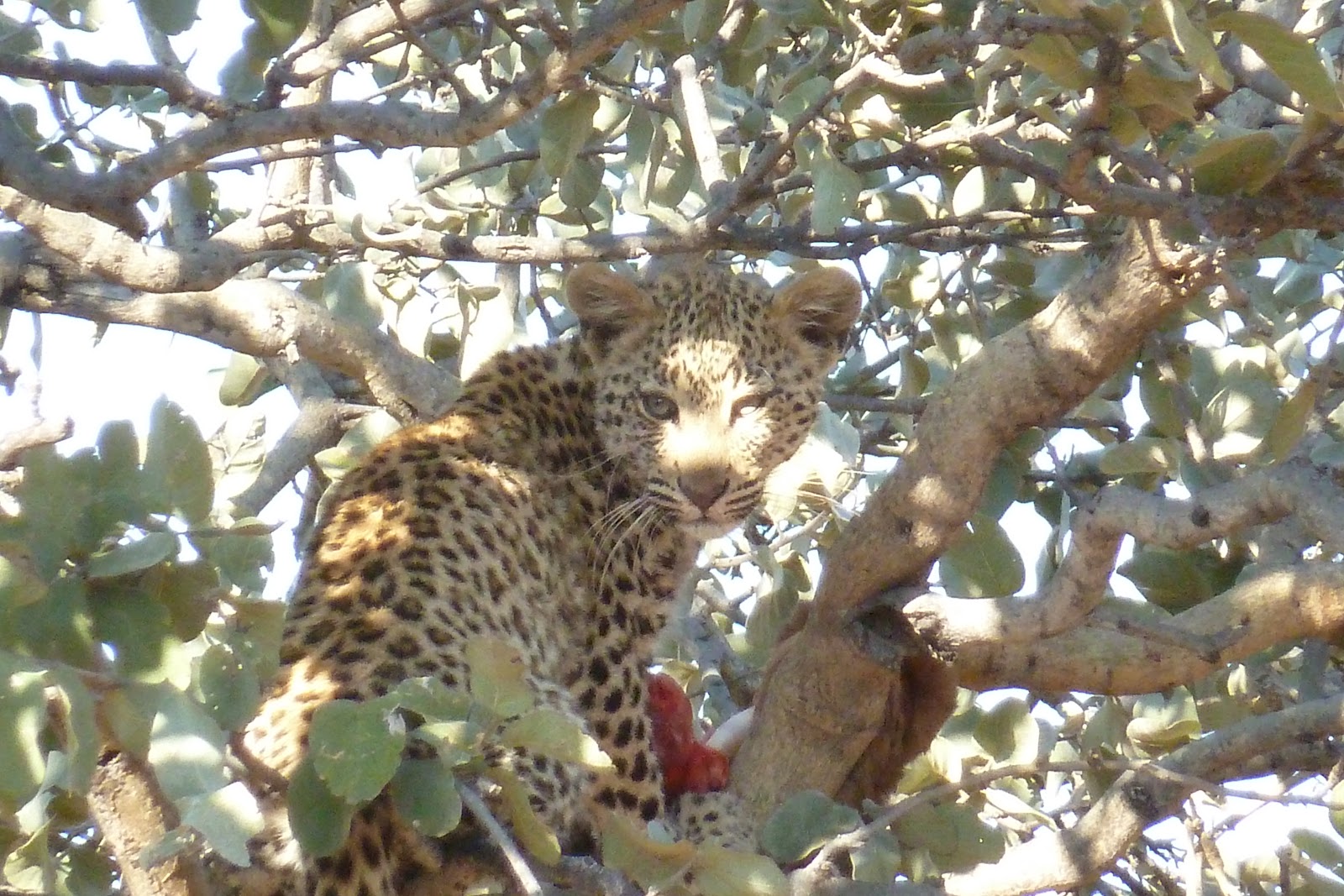
I think the highlight of the game drives has to be tracking all the 7 radio collared leopards. We only caught a glimpse of a few of the leopards, who are so well camoflaged you often don't see them until they are right in front of you. One of the leopards, MJ, has 2 6-month old cubs who she usually stashes in the mountains while she goes off to hunt for them. However they are reaching the age where they need to start accompanying mum to learn how to hunt. We were so fortunate on Sunday morning to have not only tracked MJ to a nice shady spot, but also her cubs who were busily eating a kill that she had placed in a tree for them. The cubs were only a couple of feet long and we watched them for several hours.

Barely hanging on
MJ the mother


Wild dog


Abbey the cheetah


We also tracked hyena and wild dogs. A healthy clan of hyena actually rank above a pride of lions in nature based on the power of their jaws, and I got to stand 10 feet away from one (albeit a sleeping one)! The hyena at Okonjima aren't like normal hyena because they are solitary and would never be solitary normal. This particular hyena, Pooh, was the hyena I mentioned in my post about the vet visits. Luckily he is back roaming free and in good health. Wild dogs are endangered in Africa- there are only about 500 left in the wild. It took a few attempts to track the wild dogs and when we finally saw them it was only very briefly.
Another real highlight was tracking some of the cheetahs that are in the larger rehabilitation enclosures, with the aim of eventually releasing the animals. Having worked closely with the cheetahs in the welfare enclosures and learning about the overall aim for these cats, it was good to see the ones that have a chance still. We saw 3 cheetahs- Mulder, Abbey and TinTin who are all siblings and hunt in a coalition (the name for a group of cheetah). They were all very relaxed when all of a sudden Mulder got grouchy and tried to charge us- a bit scary but luckily we were in good hands. Hopefully one day these cheetahs may be released back into Namibia, but they still need to be a bit more afraid of humans first!


Pretty cute for a squirrel!
 

I've seen plenty of game animals since arriving in Okonjima, but not all of them. The numbers and type of game are controlled in the reserve to maintain the predator-prey balance. Some typical game we have seen are Oryx (the most mountain adapted antelope), Greater Kudu, Impala (nicknamed Bambi), Steenbok (which curl up like stones when afraid- Steen=stone) and Dik-Diks which are the smallest antelope in Africa and mate for life.


One animal that I have seen more than enough of is the giraffe, however they are so graceful and yet bizarre that I never tire of seeing them! Did you know that a group of stationary giraffes is called a tower, but if they are on the move it is a journey?! A group of giraffes is more of a social group- they don't stick in family groups unless it is a mother and her calf- and they don't stay in the same group. And giraffes have the same number of vertebrae in their necks as humans! Enough of the useless facts (might come in handy for a pub quiz), and on with the pictures!


My absolute favourite animal however, has to be the zebra. In Okonjima reserve there are mainly Mountain zebra, which have white bellies, horizontal stripes down their legs, a brown patch on their snout (for lack of a better word) and a grid pattern of stripes on their butts. I didn't realise until I toured the rest of Namibia that Mountain zebra are actually quite endangered so it was a priveledge getting to see so many. [More on zebra later. I might even dedicate an entire post to them.]

Friday, 26 August 2011

Okonjima Reserve

Not so nice in the mornings
at 4 degrees with a breeze
The PAWS project is located in Okonjima Reserve, about 3 hours drive northwest of the capital, Windhoek. Once past the front gates of the reserve it takes another 40 minutes to drive to the project (to give you an idea of how big the place is). The reserve has 3 seperate enclosures: a small (supposedly predator-free) one where PAWS and the other tourist accomodation is situated; a medium one where the radio collared leopards and hyena are kept; and a large one where the cheetah are rehabilitated and which is also home to 4 wild dogs.

Other than PAWS, there are 2 basic lodges which hold all the 'common' guests, 2 exclusive villas where the rich and famous stay, and the Rare and Endangered Species Trust. Having seen the basic tourist accomodation, I certainly wouldn't be complaining if I were a paying guest!! As a basic rate people will pay about 200 pounds per night per person, and another 300 to 400 on top of that for a game drive. The exclusive accommodation costs 700 pounds per person per night, and that comes with your own host, chef and game driver. To put that into perspective, I've paid about 50 pounds per night and I get a free game drive every afternoon!! All the staff that work for Okonjima, including all the managers and the family that owns the reserve live on the reserve also.

The Campsite

A loo with a view!
The camp we are staying on was purpose built for PAWS volunteers. There are 10 tents which have 2 wooden beds inside and are big enough to stand up in, and a large porch area- luckily I've had a whole tent to myself for 2 weeks. Each tent is covered by a large A-fram consturction to protect the tents during the rain and keep them cool in the sun. There are 2 sets of bathrooms, each with 2 open air showers and 2 open air toilets ( a little scary when you see pairs of eyes reflected back at you when you're sitting on the loo at night)- the lock is a rope you put across to let people know it's in use. The sinks are metal buckets.
The lapa

There's a communal area called a lapa where food is prepared and where we spend countless hours playing cards. There's no oven so food is cooked on the fire each night. At the end of the lapa is a watering hole and a hide, built so that we can watch the wildlife as we're eating our dinner- we've seen oryx (a type of antelope), porcupine and jackal all feeding there. Every day there are 2 people on duty who prepare the meals and do the washing up. The food is quite basic but the evening meals are often good.

All in all it's a very nice little camp, and wonderful to be so far removed from all kinds of normal life.

Sunday, 14 August 2011

An apple a day keeps the dentist away...

Up to 75% of the work that africat does is funded by tourism, however with over 100 large animals to feed with 3 lots of 5kg bags of Iams per day and 12 donkies (yes donkies) per week, as well as the 4 members of staff to pay, the money does not go far. They don't have a resident vet, and calling the vet out is extremely expensive, so they keep track of which animals need vetinary attention, and when they have enough animals that need seeing they call the vet out for 3 days at a time.

 
I was extremely lucky that I was working with PAWS for one of the very few visits that the vets make every year, and as such I got to see all the action. Over 3 days I saw an incredible number of procedures. Animals in captivity are prone to dental problems, and Africat uses a vet who has specialised in animal dentistry- over the 9 years Africat have been using him, he has learnt to identify problems from just a photograph (this is only way to get an opinion on the animal's health without paying for the vet to come out).

 
Pooh the hyenah on the table
On the first night Pooh, one of the 3 spotted hyena, was darted and brought in as it was believed he had some dental problems. A clan of hyena are actually above a pride of lions in nature's hierarchy, based on the power of their jaws; simply put you keep your distance from a spotted hyena! We got to see Pooh close up on the table and even stroke him! [His teeth were fine by the way, just a bit of tartar!]

A newly toothless Willow
As I didn't get to see a procedure on a cheetah the day before, I was one of 4 who were allowed into the clinic to watch one of the welfare cheetahs, Willow, being operated on. He is one of the biggest cheetah on the reserve, and one of the oldest. Cheetah have a number of health problems as they get older, which in nature may well kill them. Cheetah tend to lose their teeth at about 8 years old, however in captivity a cheetah may live to 14 or 15. Willow is 14, and is fed only on a diet of Iams and donkey meat (no bones), however his teeth were so bad that almost all of them had to be removed. One tooth was so absessed that when it was removed the hole could fit an entire swab and you could see through the bone up to the nose.

Luckily I couldn't see the blood!
You would think I would have passed out by this point, but I conquered my fears and stayed for the whole procedure- I even held up his leg while the vet was trying to put a catheter into Willow's artery. Goodness knows what would have happened if that catherter came out, but luckily I remained standing throughout (if a little green looking).

The highlight of the week has to be going to capture Toby. Toby is a solitary cheetah living in the largest (32,000 acres) rehabilitation enclosure. An unfortunate side effect of all the farming in Namibia is that it is overgrown with invasive thorny bushes. This poses a problem to cheetah, as they are susceptible to scratching their eyes, which is exactly what happened to Toby in April this year. It took 4 darts to actually put Toby out as the darts kept bouncing off the poor guy, and he was still struggling when we got him on the truck!

 
In the wild, catching Toby
While we were there, there was actually a cameraman filming for the production company Tigress, who are producing a documentary called something like Case Files, looking at the case of Toby and how the invasive bushes are protecting cheetah from humans but also are causing injury. I was definitely filmed as part of Toby's capture, and I think I may well be in the programme so you will have to keep an eye out for me!

 
Beautiful Wahoo
On the last day, when we were supposed to be catching up on all the work that had been missed by going to see the vet checks, we got a call that a leopard called Wahoo was coming in and would we like to see him.... that was a no brainer! So we downed tools after a grouling 25 minutes and got to see Wahoo have a root canal. Wahoo was brought to Africat before his eyes were even open, taken from a farmer's land. He was brought up by Wayne Hannsen, the owner of the reserve, until Wahoo turned 4 when he matured and became a solitary animal. He is an absolutely beautiful cat who is used as an ambassador for leopards, used
to teach children about his species. We got to go and re-release him once he had been awake for a few hours- unfortunately he was still pretty dosed up so all he managed was to stand up, wobble around before slumping back down again dribbling.


Not sure if Matata was roaring more loudly
before or after the 4 root canals!
Then as if we thought it couldn't get any better, we were told that they were bringing in Matata, a fully grown, 250kg male lion! Matata had such extensive problems that they were operating on him for 4.5 hours and had to draft someone to get extra anaesthetic from the nearest town 1 hour away as he would use a bottle in himself.

I have been so lucky to not only have seen this animals up close, but stroke them, help with procedures and even have stuck my head in a lion's mouth! Not something you do every day!

Saturday, 13 August 2011

Hello from Namibia!


Sunset over PAWS
Perivoli school children
Roadside bush clearing
Trimming trees in the caracal enclosure

Tuesday, 21 June 2011

Farewell from the FIM team

Hi Sarah

We have setup this blog for you so that you can keep us all up-to-date with your travels while you are away.  Cant wait to hear all your exciting adventures!

Have a fantastic time

The FIM Team